Project
Details
-
Project Details:
-
Date: Fall 2025, Spring 2026
-
Objective: Design and manufacture a LOX fill line for a hybrid rocket to simplify launch and test operations, and minimize effects of cryogenic boil off.
-
Key elements: Cryo rated check valve, quick disconnect, fill valve, fitting stack
-
Role: Responsible Engineer (aka Project Lead)
-
Achievements:
-
Designed and manufactured all parts in system
-
Verified functionality of fill line through tests, indicating minimal leaks during fill and nominal separation and sealing of the disconnect.
-
Cryogenic Liquid Oxygen Fill System

Project Overview
In my first year at the Columbia Space Initiative (CSI) rocketry team, I worked to develop a passively activated nitrogen quick disconnect (QD) system for our launch vehicle, which resulted in a successful launch. For my junior year, I took an increased responsibility as the responsible engineer for an even more complex and performance increasing part, a cryogenic liquid oxygen (LOX) fill system, with a quick disconnect as the main focus.
While the nitrogen disconnect was necessary to allow abort, a LOX QD was not strictly needed due to dedicated abort valves. However, the lack of a LOX QD made the team’s life difficult in several ways. For one, it made our fill procedure much more clunky. To prepare for engine fire, the team first had to fill completely with LOX while keeping members at the pad wearing specialized cryogenic gear to disconnect the line when full. These team members would then have to store the line and the LOX dewar, before quickly retreating to a safe area before GN2 fill could begin. Not only was this a clunky system which added time and effort to our launch and test operations, this also allowed heavy amounts of boil off. Because LOX exists at cryogenic temperatures, once out of the dewar, much of the LOX would begin to immediately boil off in the tank through a vent valve. Calculations found that during a 17 minute period in which the COPV was filled, about 16 pounds of LOX would boil off. Our LOX tank last year was designed to hold 35 pounds of LOX, representing a 46% loss of oxidizer under nominal conditions. That loss of performance would be magnified due to an increase in ullage volume caused by the boil off, giving the nitrogen more space to expand into and decreasing the time spent at maximum operating pressure. This amount of performance loss was deemed unacceptable by the team, thus, development of a cryogenic, liquid oxygen quick disconnect was considered necessary. Filling the tank through a QD would enable team members to retreat immediately during filling procedures, and would enable top-off of LOX to the vehicle during GN2 fill, drastically reducing the effects of boil off, and decreasing the ullage volume in the tank.

Because of added components and complexity, a re-design of the entire LOX fill line was necessary to accommodate the QD. This included not just the design of the QD itself, but of various other components such as a custom cryogenic check valve and fill valve, as well as support systems such as a new low pressure GN2 line to actuate new hardware automatically.

This project marked a significant increase in both technical complexity and leadership responsibility compared to my previous design work, requiring the coordination of multiple team members to deliver a finished product. Entering the semester with uncertainty regarding new member interest, I initially focused on conveying information as clearly as possible. Drawing on my own experience as a new member, I knew how daunting the influx of technical terms and frequent meetings could be; to mitigate this, the other leads and I made a conscious effort to avoid rocket-specific jargon and prioritize open communication, ensuring new members never hesitated to ask questions. Once the core team for the fill line was established after the first month, I moved to delegate tasks. While collaborative work on a single part can sometimes yield a more refined result, I found that it often consumes excessive time and risks alienating members with conflicting schedules. Instead, I embraced a philosophy of individual project ownership. This approach allowed members to see their specific parts through from design to manufacture and launch, ultimately building greater expertise. As the Fall and Spring semesters progressed, design modifications and evolving requirements necessitated some shifts in project scope; however, throughout these changes, I ensured that every member working on the LOX line always had a clear understanding of their responsibilities and a defined goal to work toward.
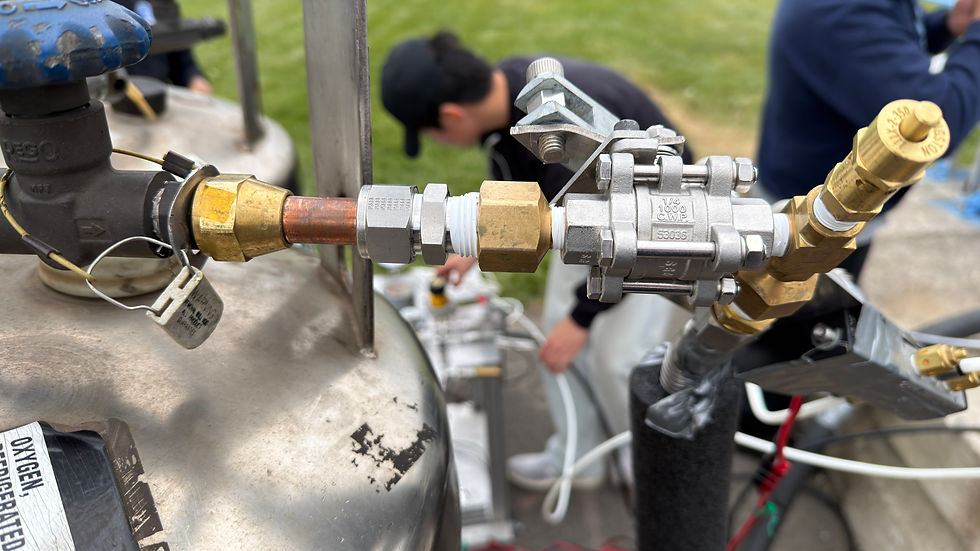
As initial design work on the custom valves began, I concurrently ensured that the LOX line would be able to be fitted and integrated with dewars, new hardware, and would function as expected. To do this, I developed a comprehensive plan detailing the system layout, necessary components, and the network of piping and fittings required for interconnection. As the responsible engineer for the system, I organized the entire line and drafted integration plans with fittings needed for attachment to LOX dewars for flight and static fires, as well as LN2 dewars for cold flow testing. Due to the usage of additional pistons to allow the fill line to function automatically, modifications were also needed to an existing GN2 stand, requiring a new 200 psi, low pressure line downstream of the high pressure line at 4500 psi. Shown here is the fitting diagram used for the LOX config filling with the quick disconnect. Configurations for launch, cold flows, and testing without the QD (as that was to be manufactured later in the spring) were used. Also shown is the modified GN2 stand with the new low-pressure section highlighted.
In order to fill automatically, a new dedicated fill valve was necessary. A pneumatically operated ball valve was also selected for this purpose. While pneumatic valves rated for cryogenic temperatures exist, their high cost exceeded our budget. Consequently, I designed a rig allowing a standard ball valve to be actuated by a GN2 cylinder. The rig consisted of a waterjet plate, and a set of spacers and thrust bearings, where a cylinder could rotate and push the valve handle while rigidly connected to the fitting stack. While initially, I selected a single acting, spring return cylinder to ensure the line was normally closed, the spring return was found to not have enough force to close the valve, thus, a double acting piston was picked. The fill valve cylinder is actuated via a 5/2 solenoid connected to the new low-pressure line in the GN2 system.


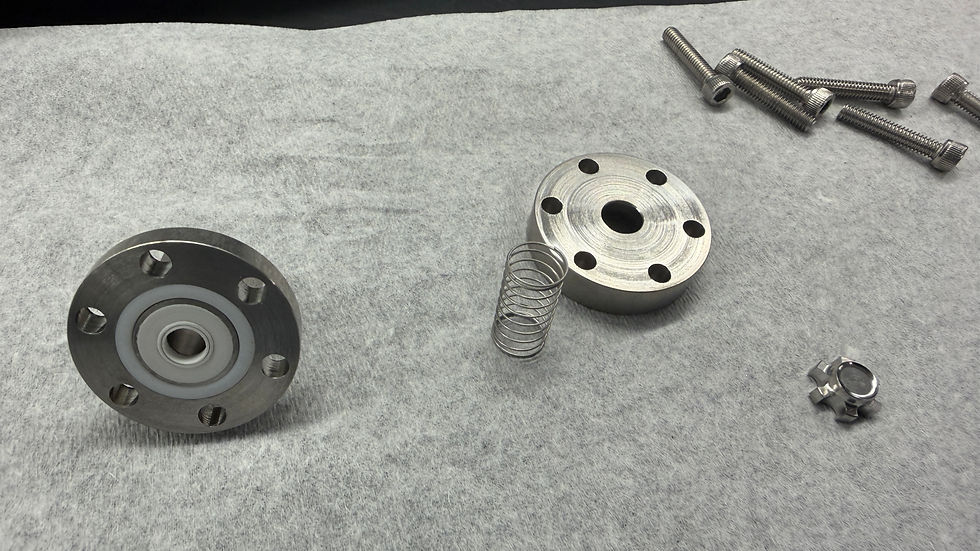
A critical component of the fill line is the one-way check valve, designed to seal LOX within the tank once the QD system separates prior to launch. While several COTS alternatives existed, we made the decision early on to pursue a custom design. This choice was driven by three primary factors. First, a custom valve offered a better form factor; by designing the valve in parallel with our oxygen tank, we were able to utilize the empty space within the end caps to house components. This resulted in a protruding length of under 1.3 inches, significantly more compact than COTS designs, which routinely exceeded 3 inches and would have complicated the packaging of other LOX system components. Additionally, this approach yielded a sturdy design that was easy to install and remove. Second, COTS check valves rated for cryogenic fluids were expensive relative to our budget. Third, designing a custom valve provided a comprehensive, dedicated project for a new member to own.
Although the check valve underwent numerous iterations to reach the final specification, the fundamental functional principles remained consistent. The assembly consists of four machined parts: an upper body, a lower body, a poppet, and a PTFE seal seat, along with a spring for compression and several O-rings to seal leak paths. The valve is bolted directly to the tank and uses a compression fitting to connect to the QD (creating the extruding inlet). Functionally, the poppet is normally pressed against the PTFE to form a knife edge seal. During filling, the pressure compresses the spring further, allowing fluid to flow in one direction; once the fill is complete and the QD separates, the poppet closes to seal against the tank pressure. Throughout development, we made several critical decisions. One major challenge was balancing spring force to create an adequate seal while maintaining an acceptable cracking pressure. We initially consulted old guidelines published by the Marquardt Corporation (now L3Harris) regarding the ratio of seal diameter to spring force for PTFE knife edges. However, adhering strictly to these guidelines, which were intended for rating seals against extremely small helium leaks, resulted in an extremely high cracking pressure. We ultimately decided to undersize our spring relative to those specifications, allowing us to achieve a cracking pressure under 5 psi (competitive with COTS parts) while still passing hydrostatic testing. We also optimized the body sizing for integration; as shown in the images, the spring extends beyond the upper body limits because it sits within the enclosure of the oxidizer tank's end cap, which allowed us to minimize the overall length. Finally, to ensure the valve would not become a flow rate bottleneck, we matched the valve sizing to the smallest orifice in the fill line (0.25 inches). Originally, the poppet was machined with 3 “blades” and 3 orifices which matched the .25 inch cross sectional area. However, the poppet was later machined with 6 blades to account for tolerance, and reduce the wobble in the valve. Later on, adjustments were also made to the knife edge seal of the poppet. Originally, the poppet was designed to seal with an edge at 6 degree angle between the poppet and PTFE. However, after intermittent small leaks were found, the poppet was remachined with a diagonal point which cut into the PTFE. This design sealed exceptionally well repeatedly through cryo cycles.
The QD represents the reason behind the re-design of the fill line, and the entire fill procedure leading up to launch is based around it. Early in the design phase, I established a requirement for simplicity and manufacturability, aiming to leverage system architectures we knew were reliable. I decided to pursue an active actuation mechanism, a distinct shift from the passive mechanism used in my GN2 QD the prior year. While the passive approach had simplified the GN2 design, an active QD offers significant advantages for LOX operations, specifically the flexibility to verify separation and sealing prior to a launch attempt. This active approach was made feasible by the inclusion of a dedicated abort valve in the system, which allowed the QD to function strictly as a one way fill point rather than requiring a two way abort mode. A final major requirement was aerodynamic flushness. While the previous GN2 QD had a very small, acceptable amount of protrusion, the LOX line, being twice the outer diameter, necessitated a design that remained completely flush with the airframe to optimize vehicle performance.
Throughout the design process, we iterated on several concepts driven by this push for simplicity. The first design we explored consisted of a pair of double acting GN2 pistons mounted to a housing. In this configuration, pads at the end of the cylinders provided compressive force to seal the interface and keep the system attached; before launch, the cylinders would extend, creating clearance for the ground-side QD to retract. This concept was ultimately rejected due to size and integration risks. Counteracting the moment forces would have required two cylinders, resulting in an excessively heavy part. Furthermore, the actuation mechanism required the cylinders to extend toward the vehicle to separate, meaning a significant portion of the hardware would remain within the airframe’s inner diameter immediately following separation. This would have necessitated an excessively large cutout and posed a high risk of the cylinders snagging on the vehicle interior during ascent.
Following this rejection, we developed two further designs for a preliminary design review. One concept was an evolution of the previous year's GN2 QD, utilizing a clip mechanism to hold the halves together, but actuated by a ground-side GN2 cylinder rather than vehicle motion to maintain the active requirement. While this design utilized a proven locking method and solved the interference issues of the piston concept, it was not selected. The primary drawback was that it could not easily achieve a flush profile without requiring an excessively large cutout or a guidance ramp to ensure the clip evacuated the airframe safely. Consequently, the team and I decided to move forward with the alternative concept, which became our final design.


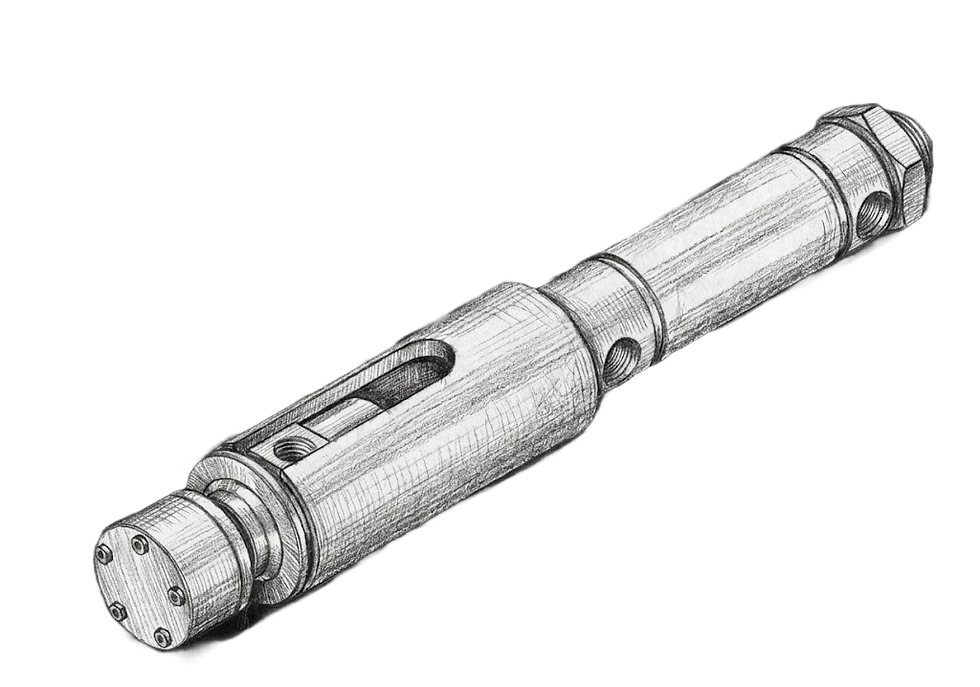
The final QD design is a custom, cryogenically rated adaptation of an industry standard ball locking mechanism. While similar COTS components exist, their high cost made them unfeasible for our budget. The assembly comprises five machined components: an inlet, outlet, retainer, sleeve, and cylinder housing. Sealing is achieved via a spring-assisted seal and a PTFE O-ring, while a spring and a grooveless snap ring retain the sleeve during operation. Mechanically, the system relies on ball bearings seated in divots within the retainer. In the default locked state, the sleeve is positioned over the bearings, restricting their outward motion. To connect the system, the sleeve is retracted, allowing the bearings to slide freely; inserting the inlet displaces the bearings until they drop into the retainer’s slot. Releasing the sleeve secures the bearings, locking the assembly in place. A key element of this design is the cylinder housing, which enables the entire separation sequence to occur in a single continuous stroke. Before launch, the cylinder retracts, pulling the housing forward. This motion first retracts the sleeve to unlock the bearings; once the sleeve bottoms out against the retainer, the continuing force pulls the ground side assembly away, ejecting it from the vehicle. This architecture allows for a compact diameter and ensures the QD remains completely flush with the airframe. Once ejected, an aerodynamic flap on a spring-loaded hinge covers the cutout in the airframe, leaving a smooth surface. The design is also braced against the run valve using two extended bolts with caps. This prevents the weight as well as any accidental nudges of the long QD from reaching the thin compression fit tube of the check valve, which was found, through FEA, to yield at a very low force at the end of the QD without the bracing. This final design was the result of a significant optimization process. The initial design, drafted by a team member, originally required seven complex machined parts and a custom face seal. Due to the large amount of complex manufacturing required, I was initially hesitant. We then worked the design to incorporate a COTS rod seal instead. This change simplified the geometry, reduced the part count to five, and lowered the machining burden, making the design feasible for production.
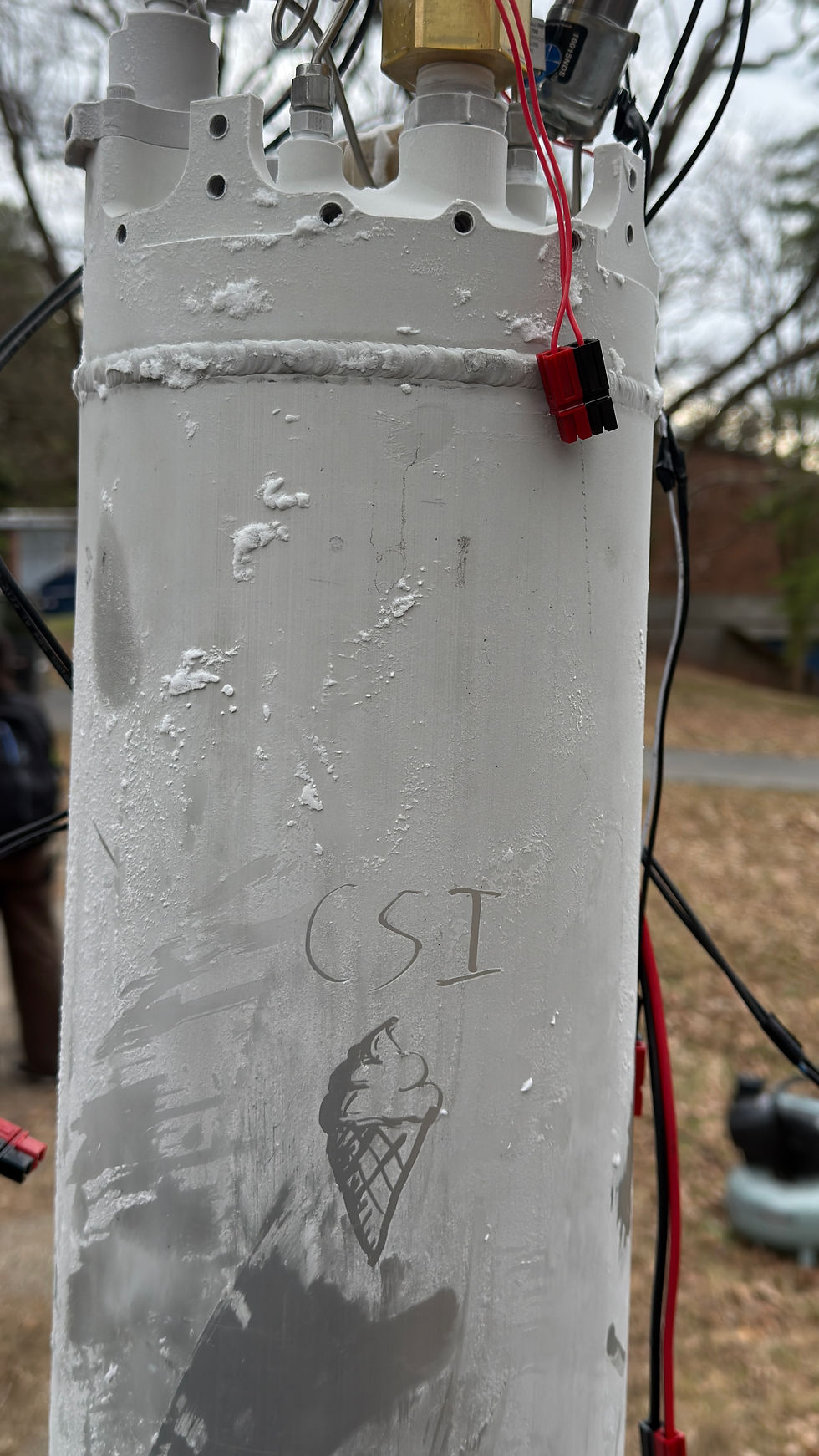
Design work on the LOX fill line was completed by the end of the fall semester in 2025. Design reviews were held over the winter break, and part orders were placed. The spring semester in 2026 almost entirely consisted of machining and testing. First, the necessities of the LOX/LN2 line fitting stack was assembled, allowing for testing with connections to cryogenic dewars. Due to the high volume of parts which needed to be machined, critical parts were prioritized. Since fill could be accomplished through the check valve alone without the QD, the check valve was given priority. The check valve was machined first, with its functionality verified during hydrostatic and cold flow tests, where it largely demonstrated its ability to seal. The improvements mentioned earlier resulted in a fully leak proof design. During the first tests, LN2 was filled manually, however, once the fill valve base was water jetted, and the full fitting stack was integrated, the fill valve was verified to allow fully autonomous fill operations. Lastly, the QD was machined. Once finished and integrated, the QD greatly simplified operations. Whilst before, testing required a cumbersome compression fit to be tightened on the vehicle and then loosened in cryo gear once filled, the QD allowed the connection to be made simply by pushing the line in. The QD actuation was tested several times both while dry and while at cryo. Once an appropriate actuation pressure was set (150psi), the QD actuated reliably every time it was tested. During fill, initially no leaks were observed. As the testing campaign continued, a small leak developed, however, this was attributed to wear and scratches in the QD probe, which would have been fixed by re-machining the probe before launch.
Unfortunately, due to other issues, the team was unable to launch the 2025/26 vehicle. Throughout the year, 8 cold flows and 2 static fires were completed. With the lox fill line executing its role perfectly. By the end of testing, all the goals set at the beginning of the year for the new system were met: Setup procedures were greatly simplified, and fill was able to be completed autonomously with total control over the ullage volume in the LOX tank. While the end result of the year was disappointing, I was incredibly proud of the work I and the team who worked on the system accomplished. I fully intend to utilize this same system for LOX fill in future vehicles.


Media Gallery